EngineeringPrecision OpticsIndustrial-Grade BuildUSA & Europe Support
Systems
Two platforms. One standard of precision.
Q-switched Nd:YAG technology engineered by iQuantum — in a compact tabletop format, and now in Aura, our new vertical platform with two handpieces and cloud connectivity.
New · Vertical platform
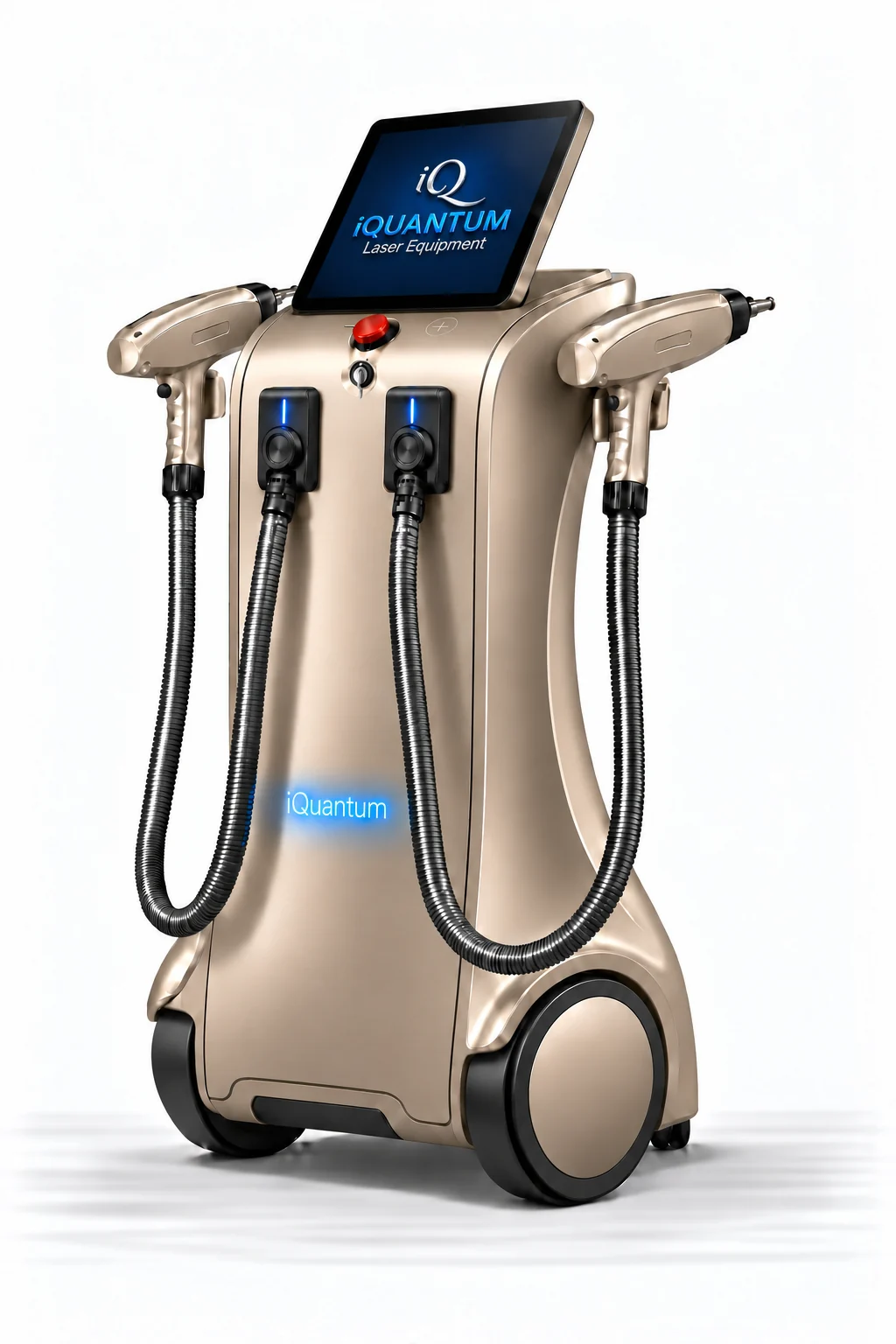
Aura
Ultra-modern vertical Nd:YAG. Two handpieces, one footprint.
Aura brings the full Q-switched Nd:YAG range into a slim, mobile body that glides between treatment rooms on its large front wheels. Every heavy component sits low; on top, only a 15-inch touchscreen connected to the cloud.
1064 · 532 · 1320nm wavelengths
2 Jmax. pulse energy
3.5 nspulse duration
10 Hzrepetition rate
1–5 mmadjustable spot
15″ Full HDtouchscreen
Two pistol-style handpieces, one active at a time
Android & cloud: remote energy and pulse settings
Water + air + TEC thermoelectric cooling
Large front wheels and integrated rear handle — no cart needed
Aura is in development. Specifications are preliminary and subject to final engineering validation. Not available for sale in the United States pending FDA 510(k) clearance.
Tabletop platform
NDX Series
Proven Q-switched Nd:YAG in a compact format.
The NDX Series delivers configurable pulse energy and three interchangeable optics in a compact tabletop unit — on the treatment trolley or on its dedicated mobile cart.
LaserQ-switched Nd:YAG
Wavelengths1320 / 1064 / 532 nm
Handpieces1, interchangeable optics
InterfaceHD touchscreen
CoolingWater + air + TEC
Weight≈ 20 kg
NDX Series — tabletop unitControl panel & handpieceMobile cart configuration
Configurable optics
Interchangeable handpieces and an adjustable spot size give precise control over energy delivery.
Advanced cooling
Combined water / air / TEC circuit engineered for sustained duty cycles and long-term reliability.
Support in the USA & Europe
Industrial-grade components, operator training through iQuantum Academy and technical support on both sides of the Atlantic.
Technology
Precision by design
Every system is built around a smart, updatable control platform — configurable energy output, a precision laser pointer guide, and a simple, intuitive graphical interface.
Smart Control Software
Updatable system software with a clear graphical interface and optional remote Cloud / App control.
Configurable Energy Delivery
Adjustable pulse energy and repetition rate, with a precision pointer guide and adjustable spot size.
Engineered for Reliability
Built with industrial-grade components and rigorous manufacturing processes designed for sustained, repeatable performance.
UNDERSTANDING THE TECHNOLOGY
What is an Nd:YAG laser?
Nd:YAG stands for neodymium-doped yttrium aluminum garnet — a solid-state crystal that, once optically pumped, emits a coherent infrared beam at 1064 nm. Passing that beam through a frequency-doubling crystal produces a second wavelength at 532 nm (visible green); the NDX platform adds a third option at 1320 nm. In Q-switched operation, energy is stored and released in extremely short, high-peak-power pulses, allowing the beam to be absorbed selectively by its intended target while limiting heat spread into surrounding tissue — a principle known as selective photothermolysis.
The longer 1064 nm wavelength penetrates deeper into tissue than shorter-wavelength lasers and is absorbed less by melanin in the skin's surface layer, which is why it is widely used as a base platform across professional and dermatological laser equipment.
APPLICATIONS
Where Nd:YAG technology is used
Nd:YAG platforms are one of the most established laser technologies in professional aesthetic and dermatological practice. Typical, well-documented application areas for this technology include:
Pigment & Tattoo Treatment
Q-switched pulses target ink and pigment particles, fragmenting them for gradual clearance — effective across a range of ink colors, particularly dark pigments.
Micropigmentation Removal
The same Q-switched, photoacoustic mechanism used for tattoo removal also fragments cosmetic pigment (eyeliner, eyebrows, lips), sparing the surrounding tissue.
Facial Rejuvenation (Carbon Peel)
A thin layer of medical-grade carbon absorbs the Q-switched pulse, lifting impurities and dead skin cells for a brighter, more even complexion.
Skin Toning
Low-fluence, non-ablative passes are used for gradual collagen stimulation and toning, without disrupting the skin's surface barrier.
Actual clinical indications, protocols and who may operate this class of equipment depend on local regulation and professional licensing in each market. This overview describes the underlying technology in general terms and is not a claim of a specific medical indication for any iQuantum Laser product.
COMPARISON
Nd:YAG vs. CO2, fractional and picosecond lasers
These four terms describe two different things: Nd:YAG, CO2 and picosecond refer to the laser medium / pulse regime that determines wavelength and pulse duration, while "fractional" refers to a delivery mode — splitting the beam into a grid of microscopic treatment zones — that can, in principle, be applied to more than one wavelength. In practice, "fractional" devices in the market are most often built around CO2 (ablative) or erbium-glass (non-ablative) sources. The table below compares them on the dimensions that matter operationally.
General technology comparison — for engineering/educational reference, not a claim about any specific iQuantum product's clearance or indication.
Control softwareUpdatable, optional remote Cloud / App
AimingPrecision laser pointer guide
REGULATORY REFERENCE
Regulatory information (for reference only)
Laser equipment used in professional and aesthetic settings is subject to regulatory frameworks in every market. The links below are provided purely as general, informational reference to those frameworks.
United States — FDA
In the US, laser products are regulated by the FDA as radiation-emitting electronic products under 21 CFR 1040.10 / 1040.11 (performance standards), and — where a medical/surgical indication applies — under the medical device framework as well.
In the EU, Annex XVI of Regulation (EU) 2017/745 (MDR) covers high-intensity light/laser equipment without a strictly medical purpose (e.g. skin resurfacing, tattoo or hair removal) — these are regulated as medical devices due to functional similarity and risk, overseen in Spain by AEMPS.
Shown for general reference only. These links describe the regulatory frameworks that apply to this category of equipment in each market. They do not state or imply that any specific iQuantum Laser product currently holds a particular regulatory clearance, certification or listing in any jurisdiction. Certification status is confirmed separately, market by market, and is not represented on this website without prior written approval.
Technical specifications describe system engineering only. See our Legal Notice for important information on the scope of this website.
Training & Support
Training & Technical Support
A growing video library of treatment protocols and equipment care guides for iQuantum NDX professionals — built to watch once, or come back to whenever you need a refresher.
Professional use only. The protocols, settings and parameters referenced in this library are specific to the iQuantum NDX platform and are not intended as universal values for other laser or IPL systems. This content is intended exclusively for professionals with accredited training and licensing in the use of aesthetic laser devices, in accordance with applicable regulations in their jurisdiction — including the United States and Spain. It does not replace hands-on professional training, manufacturer certification, or independent clinical judgment.
Treatment Protocols
Coming soon
Carbon Peel / Hollywood Peel
Application, parameters, and pass guidance for the classic "lunchtime" carbon peel protocol.
Coming soon
Tattoo Removal
Wavelength selection and pass planning for multi-color tattoo clearance.
Coming soon
Micropigmentation Removal
Protocol notes for safely lightening and removing micropigmentation.
Coming soon
Pigmentation & Skin Toning
Settings for treating superficial pigmented lesions and uneven skin tone.
Coming soon
Nail Fungus Treatment
Protocol details to be added — pending clinical review.
Equipment Care & Technical Support
Coming soon
Cooling Water Replacement
Step-by-step guide to changing the system's cooling water safely.
Coming soon
Touchscreen Care & Cleaning
Best practices for cleaning and protecting the control touchscreen.
Coming soon
General Equipment Cleaning
Routine cleaning checklist to keep your NDX system in top condition.
Coming soon
Cables & Connections Check
How to inspect cables and connections between service visits.
Looking for a specific protocol, or want early access to the full library?
iQuantum Laser USA, LLC designs and delivers professional laser systems built on precision engineering, reliability and rigorous manufacturing standards. We work with professional operators across the United States and Europe, backed by dedicated technical support.
Contact
Request information
For technical information, product enquiries or support, reach our team directly.